Scanners — Overview & Decision Graph · Volume 1
Scanners — Overview & Decision Graph
Lineup at a glance, decision graph, license envelope, and how to read the series
1.1 About this volume
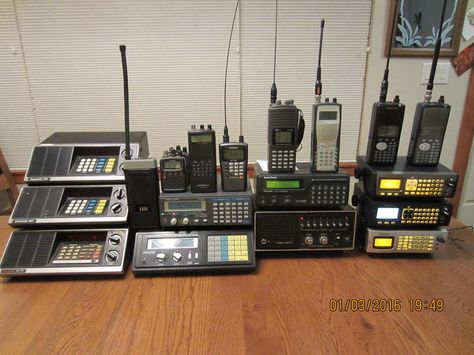
This is the navigator for the Scanners series — a per-device reference hub covering the eight Uniden monitoring scanners in the lineup, from the flagship SDS100/SDS200 through the mid-tier BCD536HP/BCD396XT to the legacy BC246T/BC350A/BC355N/Homepatrol. It tells you how to read the series, where to look for what, and how the per-device deep dives relate to the cross-cutting topic dives that accompany them.
Each owned scanner gets its own deep-dive folder following a standard template — hardware tour, operating modes, programming workflow, codeplug backups, field use, tips, resources. Cross-cutting topic dives cover the programming software landscape and the frequency-planning / license envelope across all the scanners in one place; a reference closeout holds the laminate-ready cheatsheets, A-Z glossary, and canonical anchor index.
This volume is the page that gets opened first. The per-device and topic dives are reached from here.
The sibling project Antennas (a peer top-level reference) is the 33-volume antenna-side reference; every scanner in this series pairs with antenna recommendations there (discones, wideband whips, mag-mounts). Don’t re-derive antenna content here; cross-link to Antennas Vol 29 (Use-case Matrix) which has explicit per-radio antenna recommendations.
1.2 The lineup at a glance
The owned scanners in the lineup, organized by tier. Each row points to the deep dive that covers it.
Table 1 — The lineup at a glance
| Vol | Type | Item | Bands | License tier | Posture |
|---|---|---|---|---|---|
| 10 | Scanner — flagship HT (digital) | Uniden SDS100 | 25-1300 MHz | No license (RX) | Portable |
| 11 | Scanner — flagship base/mobile | Uniden SDS200 | 25-1300 MHz | No license (RX) | Home base/mobile |
| 12 | Scanner — mid base/mobile | Uniden BCD536HP | 25-1300 MHz | No license (RX) | Home base/mobile |
| 13 | Scanner — mid HT (digital) | Uniden BCD396XT | 25-1300 MHz | No license (RX) | Portable backup |
| 14 | Scanner — legacy HT (Trunk Tracker III) | Uniden BC246T | 25-1300 MHz analog/trunk | No license (RX) | Archival |
| 15 | Scanner — legacy desktop | Uniden BC350A | 30-512 MHz analog | No license (RX) | Archival |
| 16 | Scanner — legacy compact mobile | Uniden BC355N | 25-960 MHz analog | No license (RX) | Vehicle backup |
| 17 | Scanner — legacy zip-code-programmable | Uniden Homepatrol | 25-1300 MHz digital | No license (RX) | Archival |
Four further dives sit outside the owned lineup, as references and buyer’s guides to one scanner platform: the GRE PSR-800 (2011), the library-on-microSD P25 handheld; its Whistler handheld descendants, the WS1080 / WS1088 and RadioShack PRO-668; the base/mobile branch, the WS1095 / WS1098 (the cancelled GRE PSR-900, completed by Whistler); and the current TRX-1 / TRX-2, still sold new under Goliad Products.
These scanners each get a per-device deep dive; the cross-cutting topic dives (programming software, frequency planning) and the reference closeout cover the material that spans all of them.
1.3 The decision graph — “I want to do X, which scanner?”
Use this table when the question is “I want to do this, which scanner?” The cross-link in the third column points to the deep dive that covers it in depth.
Table 2 — The decision graph — "I want to do X, which scanner?"
| Use case | First-choice scanner (with antenna note) | Deep dive |
|---|---|---|
| Monitor local public safety (PD/FD/EMS) — P25 trunked | Uniden SDS100 (HT) or SDS200 (base) — outdoor discone for base | Vol 13, Vol 14 |
| Monitor airband (AM voice, 108-137 MHz) | Uniden SDS100 / SDS200 with discone; Tecsun PL-880 for AM-only listening | Vol 13, Vol 14, Vol 11 |
| Monitor marine VHF | Uniden SDS100 / SDS200; any Uniden scanner covers 156-162 MHz | Vol 13 |
| Test equipment / bench RX | Gigatronics 6060A/6062A as sig gen; SDS200 + spectrum mode as poor-man’s SA | Vol 23, Vol 14 |
| General wideband scanning | Uniden SDS100 / SDS200 with discone — covers HF (limited) through 1.3 GHz | Vol 13, Vol 14 |
| RF safety / EMC compliance check | Cross-link to Antennas Vol 31 (Regulatory & RF Safety) and Vol 27 (Spectrum Analyzers) | (Antennas) |
When two scanners both fit a use case, the choice tilts on posture (handheld vs. mobile vs. base) and feature depth — the SDS100/SDS200 are the only units with TrueIQ baseband decoding for the latest digital trunked systems.
1.4 The license envelope
The operator holds FCC Amateur Extra-class, but the scanners in this project are receive-only by hardware and by Part 15 certification — there is no TX role for any of them. For the bands they monitor, the table below is the operating envelope. Cross-link to the deep treatment in Vol 4 (Frequency Planning & License Envelope) and the regulatory deep dive in Antennas Vol 31.
Table 3 — The license envelope
| Service | Authorization | TX legal? | RX legal? |
|---|---|---|---|
| Amateur HF/VHF/UHF/microwave (Part 97) | Amateur Extra (held) | Yes — all bands | Yes |
| GMRS (Part 95 §95E, 462/467 MHz) | $35 GMRS license (10 yr) | Need license + certified radio | Yes |
| FRS (Part 95 §95B, 462/467 MHz) | No license | Need FRS-certified radio | Yes |
| MURS (Part 95 §95J, 151-154 MHz) | No license | Need MURS-certified radio (≤2 W) | Yes |
| CB (Part 95 §95D, 26.965-27.405 MHz) | No license | Need CB-certified radio | Yes |
| Marine VHF (Part 80, 156-162 MHz) | License (on vessel) | Vessel + license | Yes |
| Aero VHF AM (Part 87, 118-137 MHz) | Aircraft station license | No (no TX) | Yes |
| Cellular (Part 22/24/27) | Carrier-issued | Carrier only | RX is legal — but ECPA §2511 prohibits intentional intercept of certain content |
| Land Mobile Radio (Part 90, various) | Site/business license | No (no TX) | Yes |
| Public safety encrypted (P25 Phase II + encryption) | Agency only | No | RX legal where unencrypted; decrypting is illegal even passively |
The asymmetry that matters: TX needs a license; RX (in most cases) does not. Scanners are RX-only and lawful across almost every frequency. Where it gets nuanced is the ECPA § 2511 carve-out for cellular and encrypted communications — see Vol 4 §5 (Part 22 cellular) ↗ for the boundary.
1.5 Categorization — scanners, radios, hotspots
Three categories of device sit across the radio shack:
Scanners — Receive-only by hardware and by Part 15 certification, and the focus of this project. The Uniden lineup spans flagship (SDS100/SDS200) → mid (BCD536HP/BCD396XT) → legacy (BC246T/BC350A/BC355N/Homepatrol). The legacy Uniden lineup is on the bench partly for historical/sentimental reasons; the flagships are the daily drivers. Modern scanners decode trunked digital systems (P25 Phase II most common) and analog conventional; the legacy BC-series scanners are analog-only, while the Homepatrol is digital — P25 Phase I on the HomePatrol-1, Phase I and Phase II (built in) on the HomePatrol-2.
Radios — TX-capable transceivers (the ham handhelds, HF rigs, DMR HTs), covered in the sibling Radios project. Bound by licensing for TX; the amateur radios require an amateur license.
Hotspots — Specialized appliances that bridge a local low-power VHF/UHF DMR signal to the internet, allowing access to any BrandMeister/TGIF/W0CHP talkgroup from anywhere with internet. Also covered in the sibling Radios project. Hotspot operation requires an amateur license.
The duality matters: a Uniden SDS100 is a scanner (RX-only); an AnyTone D878 is a radio (TX-capable). A hotspot is neither — it’s an RF transport bridge from local VHF/UHF to the internet DMR network.
1.6 The per-scanner volume template
Each scanner deep dive follows this template, so once you’ve read one you know how to read the others:
1. About this volume — overview, when this scanner earns the bench slot,
   posture (home/portable/mobile/handheld), receive-only legal framing
2. Hardware tour — controls, display, ports, battery, size/weight, build quality
3. Operating modes — bands covered, modulations, conventional/trunked/digital
4. Programming workflow — channels, scan lists, favorites, CPS pipeline
   (cross-link to the programming dive for the software)
5. Codeplug backups — versioned snapshots with file paths into ./programs/
6. Field use — antenna pairing (cross-link to Antennas Vol 29),
   posture, common gotchas
7. Tips & tricks — non-obvious operations, hidden menus, firmware mods
8. Resources — manuals, vendor links, community forums
The cross-cutting topic dives use adapted templates because they’re not single-device — the programming and frequency dives describe behaviors across the lineup, and the reference closeout is cheatsheets + glossary + anchor index.
1.7 Programming software landscape (preview)
A quick map of which software programs which radio. The programming dive has the deep treatment.
Table 4 — Programming software landscape (preview)
| Software | Radios it programs | OS | Cost |
|---|---|---|---|
| ProScan (Uniden CPS) | Uniden SDS100, SDS200, BCD536HP, BCD396XT | Windows | Paid (license) |
| Sentinel (Uniden CPS) | Uniden BCD436HP / BCD536HP family | Windows | Free (Uniden) |
| FreeScan (Uniden CPS alternative) | Uniden BC246T, BC346XT, BCD396XT, etc. (older) | Windows | Free |
| AnyTone CPS (D878UVII) | AnyTone AT-D878UVII PLUS | Windows | Free (vendor) |
| CHIRP | Baofeng F8HP, UV-B5, Yaesu VX-8DR, dozens of others | Windows/Mac/Linux | Free (OSS) |
| RT Systems VX-8 Programmer | Yaesu VX-8DR (alternative to CHIRP) | Windows | Paid |
| wfView | Icom radios (none in this lineup currently) — CI-V control | Windows/Mac/Linux | Free (OSS) |
| Pi-Star / WPSD web UI | DIY WPSD hotspot | Browser-based | Free (OSS) |
| BridgeCom config tool | SkyBridge Plus | Browser-based | Free (with appliance) |
The notable patterns: Uniden flagship line consolidates around ProScan + Sentinel (Windows); CHIRP is the universal cross-vendor backup that handles almost every cheap dual-band HT including the Baofengs and (sub-optimally) the Yaesu; AnyTone DMR has its own vendor CPS because the codeplug structure (talkgroups + contacts + roaming + APRS in one bundle) is too complex for CHIRP to handle well.
1.8 Posture mapping
Each scanner fits one or more postures. The “best” posture isn’t always the most-used — the legacy units mostly stay shelved, while the flagships do the daily work.
Home base / shack:
- Uniden SDS200 + outdoor discone (the daily-driver scanner)
Mobile / vehicle:
- Uniden BCD536HP under dash (mobile scanning)
- Uniden BC355N as a backup vehicle scanner (cheap, reliable)
Portable / field:
- Uniden SDS100 walking around (incident scanning)
Handheld / EDC:
- Uniden SDS100 for incident scanning (loud crowd / parade / event)
The legacy/archival units (BC246T, BC350A, Homepatrol) don’t have an active operating posture — they live where they live until needed.
1.9 Cheatsheet and closeout preview
Vol 25 is the closeout — laminate-ready cheatsheet cards (programming-cable pinouts, frequency-band reference, trunking-system ID flowchart, CTCSS/DCS tone tables), an A-Z glossary of radio terms used across the series, and a canonical anchor index listing every cross-deep-dive anchor that sibling deep dives can link into.
Use it as the field reference card; use the rest of the series as the bench-side deep reference.
1.10 Resources
Authoritative references:
- ARRL (Amateur Radio Relay League) — https://www.arrl.org
- FCC ULS (license lookup) — https://wireless2.fcc.gov/UlsApp/UlsSearch
- RadioReference (frequency database, scanner programming source-of-truth) — https://www.radioreference.com
Vendor sites (each scanner’s resources section links to the specific product page):
- Uniden — https://www.uniden.com
Sibling project cross-references (load-bearing — read these alongside this series):
- Antennas — 33-volume antenna deep dive
- Antennas Vol 29 (Use-case Matrix per radio)
- Antennas Vol 31 (Regulatory & RF Safety) — deep regulatory treatment
- Hack Tools comparison.md — cross-tool decision matrix
- Hack Tools/_shared/legal_ethics.md — project-wide legal/ethics baseline (applies here equally)
Comments (0)