Uniden BC350A · Volume 2
Uniden BC350A — Vol 2: Operations
Pre-trunking 100-channel desktop base
2.1 Operating modes
Modulations. Conventional analog FM only, across the bands it covers. AM mode is variant-dependent — some BC350 SKUs include AM mode for the airband (108-137 MHz); others omit it entirely. TBD — verify. The CTCSS/DCS tone-controlled squelch feature is also variant-dependent — the original BC350A as commonly documented did not include CTCSS/DCS; some later “C” or “XLT” variants did. The bench unit should be checked.
Bands covered. Conventional analog 30-512 MHz with no trunking — the band coverage is the headline spec to verify. The original BC350A typically covered VHF-Lo (29-54 MHz), VHF-Hi (108-174 MHz including airband if AM is supported), UHF (406-512 MHz), and sometimes the 806-960 MHz band with cellular gaps mandated by the ECPA. TBD — verify the exact band coverage; if the unit covers 800 MHz, it’s a slightly later variant.
What it cannot do. Trunking — none of it. No Motorola Type I/Type II, no EDACS, no LTR, no APCO P25 Phase I or Phase II, no DMR, no NXDN. The radio is a conventional channelized analog scanner. If the local public-safety system has migrated to any trunked or digital mode (most have, by 2026), the BC350A will hear the control channel and traffic channels as unintelligible chirping or unmodulated noise.
100 channel memories. Organized as a flat list (no banks in most BC350-family variants). The scan list is the same as the memory list — you mark channels as locked-out or active rather than grouping them into banks. Priority channel is a single channel, dropped into the lookup loop once per second or so during scanning.
Service search. Most BC350-family variants include pre-populated service searches (police, fire, EMS, weather, marine, aircraft) that sweep specific sub-bands without using memory channels. This is useful for spot-monitoring an unknown band — set it to “weather” and it sweeps the seven NOAA channels; set it to “aircraft” and it sweeps 108-137 MHz looking for activity. The service-search ranges are hard-coded in firmware and not user-editable.
2.2 Field use
Posture. Desktop home-base, archival. Sits on a shelf or desk in the shack; AC-powered; not intended for portable or mobile use even though the case is small enough to be transported. The lack of trunking and digital decode makes it unsuitable as a primary monitoring radio for modern public-safety scanning; the role is “what scanning used to be” reference + occasional analog repeater monitoring.
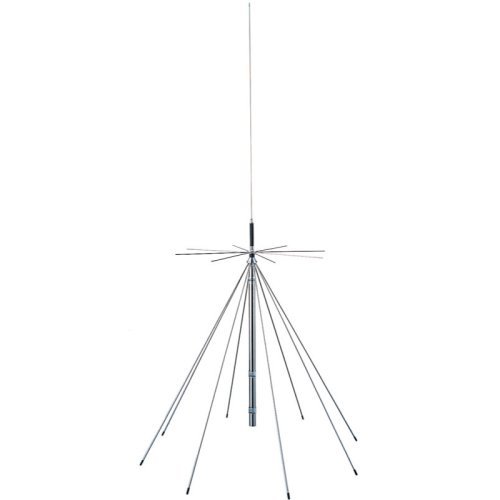
Antenna. With a BNC port and 30-512 MHz coverage, the natural pairing is a discone for omnidirectional wideband receive — Diamond D-130J or Comet DS-150S outdoors, MFJ-1868 indoors for restricted spaces. See Antennas Vol 12 (Discone & wideband) for the discone deep dive and Antennas Vol 29 (Use-case Matrix) for the per-radio antenna recommendations.
The stock telescoping whip is fine for local-coverage testing and for confirming the unit still works after years on a shelf, but for any actual monitoring the discone is the upgrade. Feedline from a roof-mounted discone to the BC350A’s BNC: a short jumper from the LMR-400 feedline’s N-male to a BNC adapter, or — better — a custom-terminated LMR-400 with N-female on the antenna side and BNC-male on the scanner side per the connector-hygiene rule in Antennas Vol 5 §9.3.
Power. AC outlet always. No 12 V cigarette-lighter adapter unless one was sourced separately, and even then the radio expects to be mains-powered.
Operating envelope. Receive-only, lawful across the entire band coverage with the conventional ECPA caveats for cellular content. See Vol 4 (Frequency Planning & License Envelope) for the full receive-side legal envelope.
Comments (0)