Uniden SDS200 · Volume 2
Uniden SDS200 — Vol 2: Operations
Sibling of SDS100 with more output/inputs
2.1 Operating modes
The operating-mode set is identical to the SDS100 — TrueIQ baseband-decoded P25 Phase I + Phase II, DMR (in the same 6.25 kHz / 12.5 kHz channel layouts), NXDN (both 4800 and 9600 bps), Motorola Type II / IIi smartnet/smartzone trunking, EDACS (both narrow and wide), LTR conventional and standard trunking, plus all conventional analog FM/AM. P25 Phase I and Phase II are standard; DMR, NXDN, and ProVoice are separate paid upgrades — each a per-radio key bought through my.uniden.com (about $60 for DMR and $50 each for NXDN and ProVoice as of 2025–26), entered on the radio under Menu → Settings → Upgrade. A fourth key (about $20) unlocks the Waterfall spectrum display. Details in Vol 5 — Upgrades & Firmware. Discovery mode (frequency-range search with hit-logging to SD card), service searches (pre-populated police/fire/EMS/civil-air/marine/ham scan plans), close-call (RF-near-field detection of strong nearby transmitters), and the GPS-based site-selection logic are all the same code as the SDS100 — and, like the SDS100, the SDS200 needs an external GPS receiver for it.
For the full digital-mode treatment, read Vol 13 §3 (Operating modes) ↗ — the TrueIQ-vs-heterodyne architectural distinction, the P25 Phase I/II differences (FDMA vs TDMA-IMBE), the DMR mode-mapping, the NXDN superframe structure, the ProVoice context (the digital voice mode used on some EDACS systems), and the discovery-mode workflow are all explained there and apply unchanged to the SDS200.
The two functional deltas that matter for operating-mode behavior on the SDS200:
- GPS comes from the rear GPS jack. Neither SDS model has a built-in GPS receiver. For GPS-based site selection (the automatic avoid/un-avoid of sites and departments based on physical location), connect an NMEA-0183 serial GPS receiver to the SDS200’s rear GPS jack and set the serial-port baud rate to match. For a fixed base install GPS is unnecessary — set the location by ZIP code or coordinates. For a vehicle install that moves between coverage areas, an external GPS keeps site selection current automatically.
- Ethernet-remote operating mode. A capability the SDS100 does not have. With ProScan connected over LAN, the operator can monitor the radio from a different room (or, with NAT/VPN, from a different building) — including streaming live audio, watching the scan-status display, and editing the favorites file without disturbing the radio’s physical install. This unlocks operating postures impossible on the SDS100: the radio lives at the feedline-entry point (basement, attic, antenna-mast base) where coax loss is minimized, and the operator interacts with it from wherever is comfortable. The Ethernet stream protocol is ProScan-specific (TCP-based, with the audio carried over UDP); third-party clients exist (community-maintained Python clients are on GitHub — verify current best option), and the protocol has been reverse-engineered enough that custom integrations are tractable.
The Broadcastify-feed use case deserves a sentence: Broadcastify (formerly RadioReference Live Audio) is the community scanner-streaming service that lets one operator feed audio to a worldwide audience. The SDS200 + Ethernet + ProScan stack is the lowest-friction way in the Uniden ecosystem to set up a Broadcastify feed — no PC sound-card capture required, no audio-cable runs, no clipping/level concerns from analog audio paths. Configure ProScan as a Broadcastify-streaming source pointed at your Broadcastify-assigned feed credentials, and the SDS200 becomes a stream node. (Legal envelope: broadcasting scanner content is RX of public-safety voice, which is lawful in most US jurisdictions but does have state-level restrictions in a handful of states — see Vol 4 (Frequency Planning) for the state-by-state survey before publishing a feed.)
2.2 Field use
The SDS200 is designed for two postures: fixed home-base shack scanner and vehicle-installed dash scanner. The antenna and posture choices differ between them; both are covered.
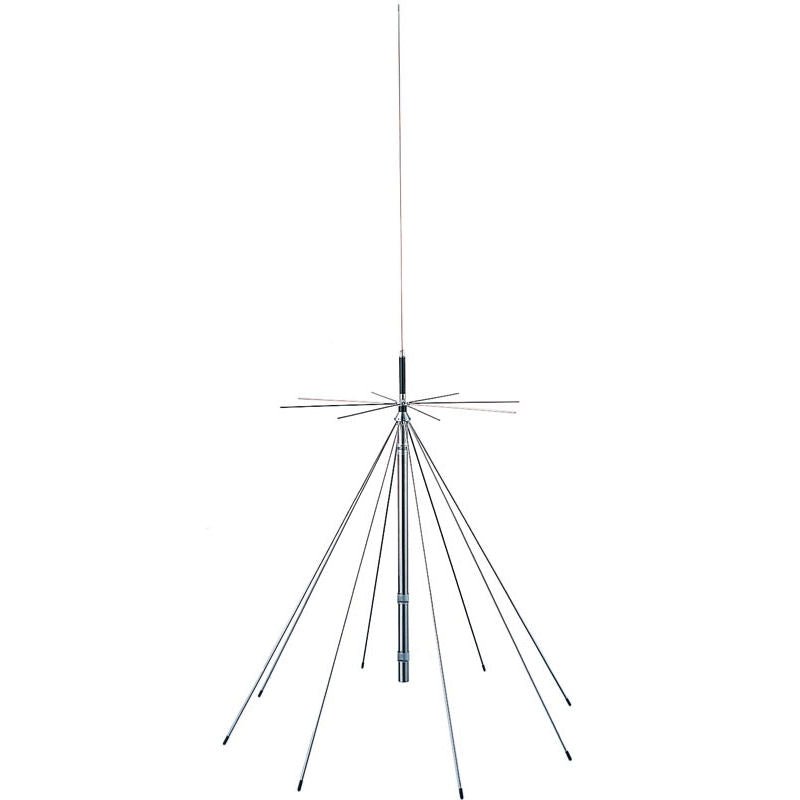
Home-base posture — outdoor discone with low-loss feedline. This is the SDS200’s killer use case and the reason it earns the bench slot. Pair the SDS200 with an outdoor discone antenna at the highest mast/roof position the install can accommodate. Top picks:
- Diamond D-130NJ (~$130) — 25 MHz – 1.3 GHz wideband discone, N-connector base (use a short N-to-BNC patch cable), about 5’ tall, the de facto standard wideband scanner antenna in the home-base market. Pattern is omnidirectional in azimuth, ~horizontal-to-low-angle in elevation, with the discone’s characteristic broadband impedance match (~2:1 SWR or better across its rated range, which is the relevant figure of merit for a receive-only antenna).
- Comet DS-150S (~$110) — similar discone, slightly different geometry, slightly broader rated range (~100 MHz – 1.5 GHz), N-connector base.
- Tram 1410 (~$80) — budget-tier discone, narrower rated range but adequate for the VHF/UHF public-safety and aero bands, mag-mount option available for those who can’t roof-mount.
Feedline: For a roof-mount discone, LMR-400 from the antenna feedpoint to the equipment-rack entry point, transitioning to a short run of RG-58 or RG-8X for the bench drop to the radio. LMR-400 loss at 800 MHz (the upper public-safety end) is about 2.7 dB per 100 ft — for a typical 50-ft feedline run from roof to basement, that’s ~1.4 dB of loss, which is acceptable. RG-58 over the same run would be ~4 dB, which starts to matter for marginal signals. See Antennas Vol 12 (Discone & wideband) for the full discone deep dive and Antennas Vol 5 (Transmission lines) for the feedline-loss math.
Vehicle posture — NMO mag-mount on the roof, BNC adapter at the radio. For dash-installed SDS200 in a vehicle:
- Antenna: A NMO mag-mount dual-band/wideband whip is the standard answer. The community pick is the Comet SBB-5NMO or the Larsen 2/70-B — both are dual-band 2m/70cm whips, well-matched to the public-safety VHF (155 MHz) and UHF (450/800 MHz) bands that account for most vehicle-scanner traffic. For wider coverage including airband and military air, a Comet B-10NMO wideband whip (25 MHz – 1.3 GHz, ~17” tall) is the wideband-receive answer at the cost of slightly compromised per-band gain.
- Mount: Magnetic NMO mount on a clean steel roof surface gives ~5-6 dBi vehicle-ground-plane augmentation for VHF (the steel roof acts as a 1/4-wave ground plane at 2m); for non-steel roofs (aluminum, fiberglass) the same antenna performs noticeably worse and a different mount strategy (lip-mount on a steel hood/trunk, or an unun-fed no-ground-plane antenna) is needed.
- Feedline: Pre-terminated NMO mount cables ship with PL-259 or BNC; for SDS200 use, BNC is direct, PL-259 needs a UHF-female-to-BNC-male adapter.
- See Antennas Vol 9 (Portable & mobile monopoles) for the deep dive on NMO mag-mounts, hood/trunk lip mounts, and the no-ground-plane workarounds for fiberglass-roof vehicles.
Power:
- Bench install: 13.8 V regulated DC at 2 A. An Astron RS-12A (linear, ~$130) is the classic shack supply; a Powerwerx SS-30DV (switching, ~$175, 30 A capacity with headroom for additional radios) is the modern pick. The supplied Uniden wall-wart works fine if you don’t want to go to a regulated supply.
- Vehicle install: 12 V DC from the vehicle accessory bus. Hardwire to an ignition-switched 12 V source rather than tapping the always-hot battery feed — this ensures the SDS200 powers off when the vehicle shuts down, preventing battery drain on long parking events. A 3 A in-line fuse at the source tap (the SDS200’s 1.5 A peak draw plus headroom) is the right protection.
Posture mapping for combined ownership (SDS100 + SDS200):
- SDS200 lives at the bench/dash 24/7 with a permanent antenna and power feed.
- SDS100 lives on the charger and gets pulled when mobility is needed (incident response, event scanning, travel to an unfamiliar area, walk-around use).
- Same favorites file curated centrally and written to both — when one radio’s codeplug is updated, the other gets the same write within the same session (§5).
The combined-ownership posture is the “passive, always-on home/dash scanning + mobile incident scanning” pair, and it’s the use case the SDS line was designed around.
Comments (0)