Uniden BC355N · Volume 1
Uniden BC355N — Vol 1: Introduction & Hardware
Compact analog scanner — NASCAR/race-day staple
1.1 About this volume
The Uniden BC355N is the compact mobile analog scanner in the lineup — a small, plain, conventional analog receiver introduced around 2008-2010 that Uniden has kept in continuous production for nearly two decades because the NASCAR / IndyCar / road-racing market keeps buying it every spring. A deliberately minimal radio: 300 programmable channels (three banks of 100) alongside its preprogrammed service banks, conventional analog only, no trunking, no digital, no SD card, no GPS, no Bluetooth.
The bench role is the always-in-vehicle backup scanner that doesn’t need attention — sits in the truck on a hardwired 12 V tap, decodes anything analog on conventional public-safety, race-team, marine, GMRS/FRS, or aviation channels, never gets touched. When the flagship SDS100 ↗ or SDS200 ↗ is in the shack or on the belt, the BC355N is the one that stays in the vehicle. Street price mid-2026 USD around $130-170 new, $80-120 used — cheap enough to leave in a vehicle the writer would not leave a $700 SDS100 in.
Why this radio still earns a slot in 2026 against trunked/digital flagships: conventional analog UHF is what every NASCAR, IndyCar, IMSA, NHRA, and most SCCA / club race team broadcasts on — licensed business-band UHF, point-to-point voice without trunking latency or trust dependencies. A flagship trunking scanner is wasted on a single conventional channel; the BC355N hears exactly the same audio. Factory-loaded service banks cover police, fire/EMS, aircraft, marine, NOAA weather and CB frequencies. Low current draw (<500 mA), tolerates 11-14 V from any vehicle / deep-cycle battery. Survives a week parked in the driveway on a 7 Ah AGM with no engine charging.
What this volume does not cover, because the radio cannot do it: P25 Phase I/II, DMR, NXDN, ProVoice, EDACS, Motorola trunking, LTR, OpenSky, MPT-1327, any encrypted system, simulcast correction, GPS site selection, Wi-Fi, SD recording, or audio recording. For any of those, see SDS100 ↗, SDS200 ↗, or BCD536HP ↗. The BC355N is intentionally the dumb end of the lineup.
Sibling context inside the legacy-Uniden cluster: BC246T (Vol 17) ↗ is the legacy handheld trunking scanner (Trunk Tracker III, analog trunking only); BC350A (Vol 18) ↗ is the legacy desktop analog conventional — same feature class in a base chassis; Homepatrol (Vol 20) ↗ is the zip-code-programmable digital — much more capable but not the right answer for “always in the vehicle.”
1.2 Hardware tour
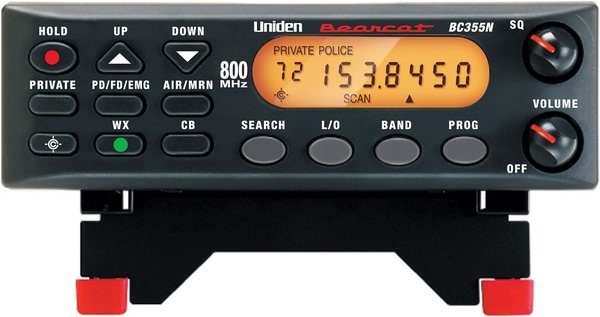
The owner’s manual gives the BC355N’s size as 5-3/16” (W) × 5-3/4” (D) × 1-5/8” (H) and its weight as 1 lb 6.5 oz. The front panel carries a VOLUME control/power switch, an SQ (squelch) control, and keys: the bank keys PD/FD/EMG, AIR/MRN, WX, CB and PRIVATE, plus HOLD, UP, DOWN, SEARCH, BAND, L/O, PROG and Close Call. There is no numeric keypad.
Display: a 7-segment LCD showing the current channel or its frequency, with mode, status and bank indicators. The manual describes no alpha tags; channels show as numbers and frequencies only.
Antenna jack: BNC, rear panel. The right choice for receive-only mobile scanning — mates cleanly with a BNC-to-NMO adapter and any mag-mount or hardwired NMO antenna. The stock ~15-20 cm BNC stub is adequate for desktop bench use and useless in a vehicle; replace immediately (see §6).
Power: 13.8 V DC nominal via a 2.1 mm coaxial barrel jack (center-positive, universal Uniden convention). Ships with a cigarette-lighter cord and a wall-wart AC adapter (~12 V DC, 500 mA). For permanent vehicle install, replace the cigarette-lighter cord with a hardwired tap to an accessory-switched fuse circuit. Current draw 200-450 mA depending on volume and backlight.
External speaker jack: 3.5 mm mono on the rear; disables the internal speaker when plugged in. This is the under-dash use case: hide the radio in the glove box, run audio to a 3” panel-mount speaker on the dash.
No PC connection: the rear panel carries only ANT (BNC), EXT SP and DC 13.8V (owner’s manual, p. 28). There is no USB, serial or cloning jack, so all programming is done from the front panel and no firmware updates or PC software exist for the radio.
Internal layout (per teardown reports): single PCB with a discrete superhet front end, audio amp, and a microcontroller running Uniden house firmware. No FPGA, no SDR front end — a classic 2000s-era heterodyne scanner. The architecture is exactly why the radio is small, cheap, and analog-only. No battery compartment; for battery-powered use, run from an external 12 V pack via the barrel jack.
Comments (0)