Uniden BC355N · Volume 2
Uniden BC355N — Vol 2: Operations
Compact analog scanner — NASCAR/race-day staple
2.1 Operating modes
Coverage is the canonical Uniden mobile-analog spec: 25-54 MHz, 108-174 MHz, 406-512 MHz, and 758-960 MHz, with the standard cellular block exclusion (824-849 / 869-894 MHz firmware-blocked per the FCC-required cellular block on Part 15 scanners sold in the US). The upper 758-960 MHz segment covers the public-safety 700/800 MHz bands but only the conventional analog channels — the radio cannot follow a trunked control channel, so any Motorola Type II, P25, EDACS, or LTR system there will sound like garbled control-channel data or silence.
Modulation: FM only. The 108-137 MHz aviation band is AM-modulated, and the BC355N’s narrowband FM detector produces buzzing audio on AM signals rather than clean voice — the radio is not practically airband-capable despite covering the frequency range. (SDS100 ↗, SDS200 ↗, and BCD536HP ↗ auto-select AM/FM/NFM/WFM per channel; the BC355N does not.)
Channels: 800 memories in 10 banks of 80. Each channel stores frequency, an 8-character alpha tag (PC-programmed only), a CTCSS or DCS squelch tone (PL/DPL, called “CT/DCS” in the menus), and a lockout flag. Channels lockout-skip during scan, banks can be enabled/disabled, and a hold key parks the radio on the current channel.
Pre-programmed banks: the factory codeplug populates banks by service category — NASCAR / IndyCar / Pro Rally race-team frequencies in upper UHF business band, NOAA weather (162.400-162.550 MHz), marine VHF 156-162 MHz, GMRS/FRS in the 462/467 MHz block, common conventional public-safety simplex / mutual-aid channels (151.475, 151.640, etc.). Factory bank assignments vary by revision year — Uniden updates the NASCAR list periodically as race teams move channels. Treat it as a starting point you’ll edit with PC software.
Service search modes: hardcoded ranges for Police, Fire/EMS, Ham (10/6/2 m + 70 cm conventional), Marine, Aviation, Weather, Racing, Special. Useful in a new region before local frequencies are programmed — the radio sweeps and stops on activity; Func + E copies a hit to memory.
Close Call: the standout feature at this price tier. Uniden’s RF-detect mode monitors for strong nearby transmitters across the receive range and auto-tunes to the strongest. Three modes — DND (checks only during scan idle), Override (interrupts active reception), Off. Useful for “what’s that signal” in unknown RF environments and as a quick discovery tool. Detection bandwidth is wide; false-positives on physically close FM broadcast or paging transmitters.
Squelch: rotary pot on the front panel, standard carrier squelch. CTCSS/DCS tone squelch is per-channel — set the tone in programming and squelch opens only on that tone. Useful for rejecting other-region interference on shared conventional frequencies (opening squelch only on the local PD repeater when several PDs in the region share a frequency with different PL tones).
2.2 Field use
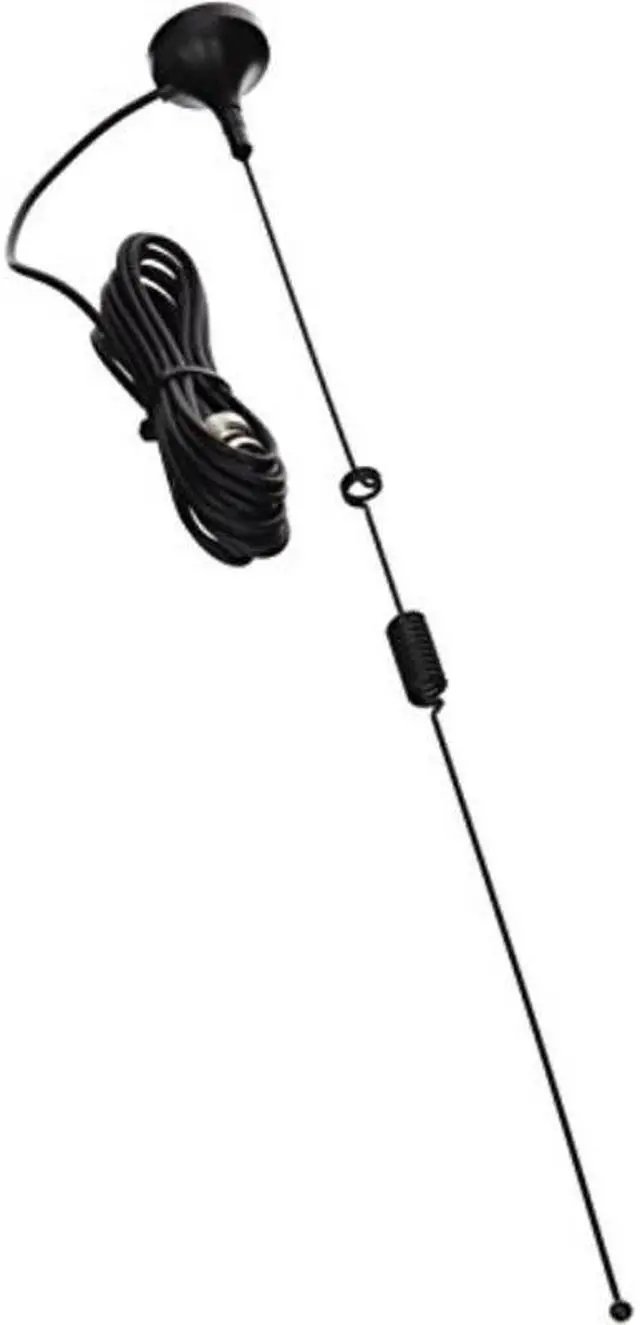
Antenna pairing — the single most important upgrade for this radio. The stock BNC stub is a token, not a real antenna. Three good choices by posture:
- Vehicle (the primary use case): NMO mag-mount on the vehicle roof with a BNC-to-NMO adapter (Larsen NMO-150/450 dual-band or similar) feeding the radio over 2-3 m of RG-58 or LMR-240. The roof gives a ground plane equivalent to an infinite radial system; expected gain over the stock stub is 6-10 dB at VHF and 4-8 dB at UHF. See Antennas Vol 9 (Portable & mobile monopoles) and Antennas Vol 29 (Use-case Matrix).
- Desktop / bench: Diamond D-130J or Comet DS-150S discone, rooftop / mast / attic. Wideband, near-omnidirectional, well-suited to the 25-960 MHz coverage. Stock-stub-to-discone delta is on the order of 10-15 dB across most bands.
- Trackside (NASCAR / IndyCar): the stock stub is actually adequate in the pits or grandstands within a few hundred meters of the transmitting handhelds — the trackside posture is the one case where it earns its keep.
Posture: vehicle-mounted backup scanner — always-on while driving, no operator interaction required. Mount the radio under-dash or in the console, run external-speaker audio to the headliner or a side-pillar mount. Wire the 12 V tap to an accessory-switched circuit so the radio powers down with the ignition. Feedline through the firewall via a standard automotive grommet. Once installed, the radio sits there for years; the only reasons to touch it are NASCAR-weekend codeplug swaps or relocating vehicles.
Receive-only: the BC355N transmits nothing — no Part 95/97/90 envelope. ECPA § 2511 still applies to intentional intercept of cellular and encrypted communications (see Vol 1 §4 ↗ and Vol 4 (Frequency Planning & License Envelope)), but the radio is firmware-blocked from cellular per the Part 15 cellular-block requirement on US-market scanners.
RF environment gotchas:
- Front-end overload in dense urban environments. The BC355N’s superhet front end has limited intermodulation rejection compared to modern SDR scanners. Near a high-power FM broadcast or paging transmitter the radio may go deaf or hear phantom signals. Fix: FM broadcast bandstop filter (~$30) inline between antenna and radio for the worst sites.
- NASCAR pit road frequencies are licensed UHF business band (typically 450-470 MHz block), not amateur or public safety. The race teams hold the licenses; you are listening, not transmitting, so you are clean.
- Mobile installation grounds: tie the radio chassis (via the negative power lead) to the vehicle chassis at a clean point — alternator whine and electrical noise floor can otherwise dominate weak-signal reception.
Comments (0)