Uniden Homepatrol · Volume 2
Uniden Homepatrol — Vol 2: Operations
Load-by-location digital scanner, no per-channel programming
2.1 Operating modes
The HomePatrol covers receive-only across 25-512, 758-824, 849-869, 894-960 MHz with the standard cellular-band blocking gaps (824-849 and 869-894 MHz — the legacy AMPS cellular block that ECPA §2511 makes interception of unlawful even when the rig can technically tune it). Some HP-2 production runs extended coverage above 960 MHz into the 1240-1300 MHz amateur 23 cm band; TBD — verify against the unit on its specific top-end coverage by checking the Scanner Information screen (menu → settings → about → frequency coverage).
Modulations supported:
- Conventional analog FM (narrow and wide), AM (aircraft band), CTCSS/DCS squelch decode.
- Motorola Type I / Type II trunked (analog) — the legacy public-safety standard before the P25 transition.
- EDACS (Ericsson’s trunked protocol, used by some state systems through the early 2000s) — analog.
- LTR (Logic Trunked Radio) — older commercial-fleet trunked analog.
- P25 Phase I (FDMA, 9600 baud C4FM) — the standard modern digital public-safety system as of the late 2000s.
- P25 Phase II (TDMA, two-slot) — the modern upgrade adopted by most major metropolitan systems through the 2010s. HP-2 only; requires the paid Phase II upgrade key.
The paid Phase II upgrade is a one-time per-unit unlock keyed to the scanner’s electronic serial number; Uniden sells it through their web store. Current pricing is TBD — verify against the Uniden web store, but historically it has been in the $60-80 range. Without the unlock, the scanner detects Phase II traffic and reports “TDMA voice” with no audio. Most major US metropolitan public-safety systems migrated to Phase II between 2012 and 2020, so a HomePatrol-2 without the Phase II unlock is now mostly useful for rural and small-town conventional systems plus the dwindling number of Phase-I-only state and county systems.
The HomePatrol does not decode DMR, NXDN, or ProVoice — those require the Vol 13 (SDS100) or Vol 14 (SDS200) flagship line with their separate paid upgrades, or Vol 15 (BCD536HP). The HomePatrol’s market position was always public-safety-first; the commercial / utility / amateur DMR-NXDN ecosystem fell outside its scope and Uniden never back-ported those decoders to the HomePatrol firmware.
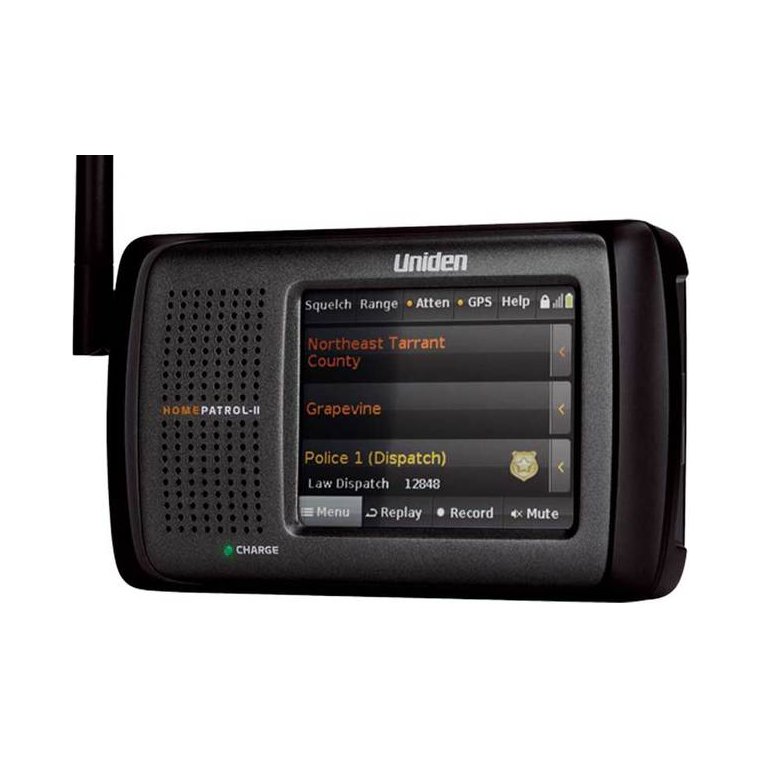
ZIP-code-driven loading is the headline operating mode. From the main screen → “Select Location” → enter ZIP code → the scanner queries its internal RadioReference snapshot and presents a list of every system serving that ZIP’s county and the immediately adjacent counties, with simple on/off toggles per system and per category (Law / Fire / EMS / Federal / Aircraft / Business / Amateur / Railroad / Marine / etc.). Tap the categories you want, tap “Scan” and the scanner is monitoring within 10 seconds. The same workflow accepts a county name or a state-and-county pair if the ZIP is ambiguous or unknown.
GPS-driven loading (HP-2 with GPS module) is the same workflow but automatic: the scanner watches the GPS feed, and when the lat/lon moves outside the radius of the currently-loaded location it re-queries and re-loads. The transition takes 15-20 seconds during which scanning is paused; the scanner then resumes on the new location’s systems. The radius is configurable (default ~16 km / 10 mi).
2.2 Field use
The HomePatrol earns its bench slot in three deployment postures: home base, travel companion, and guest / non-technical-user appliance.
Home base is the most common use. Plug the AC adapter in, attach a real outdoor antenna via BNC, enter the home ZIP, leave it running. The supplied stubby whip is acceptable for occasional listening but loses 6-15 dB of signal versus a proper outdoor antenna; the recommended upgrade path is an outdoor discone (see Antennas Vol 12 (Discone & wideband) — Diamond D-130J or Comet DS-150S are the canonical mid-tier choices), fed by LMR-400 from the mast to the scanner with a BNC adapter at the scanner end. The discone covers 25 MHz to 1.3 GHz with 0-2 dBi gain across most of the band, which is exactly the HomePatrol’s tuning range. For VHF-high (the 150 MHz state-police systems and the 138-174 MHz public-service band more generally), a half-wave VHF vertical adds another 3-4 dB but at the cost of giving up the UHF and 800 MHz coverage — usually not worth the tradeoff for a general-purpose scanner.
Travel companion is the HomePatrol’s distinctive use case. The workflow: before leaving home, plug the scanner into Sentinel, refresh the database if it’s been more than a couple of months, then on the road simply enter the destination ZIP when you arrive. For a multi-stop trip without the GPS module, this means a few seconds of menu-tapping per stop; with the GPS module it is automatic. The supplied whip is usually adequate for travel use (hotel room, rental car, in-bag monitoring at a conference) because the trip-relevant systems are the high-power public-safety repeaters that are easy to receive even on a compromised antenna.
For vehicle use, the 12 V vehicle adapter and a magnetic-mount external antenna are the right combination. See Antennas Vol 9 (Portable & mobile monopoles) — an NMO-base mag-mount with a dual-band VHF/UHF whip covers the bulk of vehicle-use scanning. For the antenna-selection trade-offs across the full radio bench, see Antennas Vol 29 (Use-case matrix).
Guest / non-technical-user appliance is the HomePatrol’s third use case and the one that no other scanner on the bench fills. Hand the HomePatrol to a visitor (kid, relative, casual hobbyist) with no scanner experience and within five minutes of pointing them at the ZIP-code entry screen they are listening to local public safety. The same conversation with Vol 13 (SDS100) or Vol 15 (BCD536HP) takes 30-60 minutes of “what is a talkgroup” before any audio is heard. The HomePatrol’s onboarding-friendliness is genuinely a different product category from the more capable scanners.
Posture: receive-only across the board. Like every scanner in Vols 13-20, the HomePatrol has no transmit capability, no TX hardware, and presents no licensing question for normal listening. The standard receive-legality framing applies — most bands are lawful to monitor; cellular and explicitly-encrypted public-safety traffic remain off-limits per ECPA §2511 (see Vol 4 §5 ↗ for the boundary treatment).
Comments (0)